Choosing an outdoor bench involves more than comparing appearance and purchase price. You need to weigh frame material, user comfort, corrosion exposure, anchoring, repair access, and installation effort so the finished seating remains safe and serviceable in its actual setting.
Key takeaways
- Choose replaceable slats instead of an all-cast-iron seat.
- Confirm frame weight, slat material, fixings and repair access.
- Specify a coating system for moisture, salt and local climate.
- Plan anchoring, accessibility and impact repairs before installation.
What cast iron adds—and what other bench materials do better
A cast-iron bench usually means cast-iron end standards or legs, not a cast-iron seat. Pairing the frame with timber, recycled-plastic, steel, or FRP slats lets you replace one damaged board instead of discarding the whole bench.
The heavy frame resists casual movement and damps vibration, but it needs more transport and lifting effort than aluminium or thin-walled steel.
| Option | Practical advantage | Main drawback |
|---|---|---|
| Cast iron | Stable, impact-resistant appearance; strong in compression; durable when coated | Heavy, brittle under sharp impact, and difficult to weld reliably; casting cavities retain water |
| Steel | Lighter, tougher under impact, and easier to weld or modify | Rusts quickly where coating is damaged; may need heavier sections or anchoring |
| Aluminium | Lightest handling and strong corrosion resistance | Higher material cost, softer under impact, and easier to move or steal |
| RCC benches | Very stable, vandal-resistant, and low-maintenance after installation | Permanent, uncomfortable without a separate seat surface, and difficult to relocate or repair |
| Timber | Comfortable temperature and easy local replacement | Needs sealing, drainage, and inspection for rot, splitting, and vandalism |
| Fully FRP | Light, corrosion-resistant, and mouldable into continuous forms | Can fade, scratch, flex, or suffer difficult colour-matched repairs |
For cast iron versus steel benches, choose iron when mass and traditional appearance matter more than field repair. Cast iron versus aluminium benches is mainly a stability-versus-handling decision.
Compare timber benches vs FRP benches by climate and maintenance capability: timber feels better in sun, while FRP avoids rot but can become hot and is harder to repair invisibly. Any iron seat surface carries the greatest cold-and-sun heat penalty.
Confirm the frame, slats, weight and repair details before buying
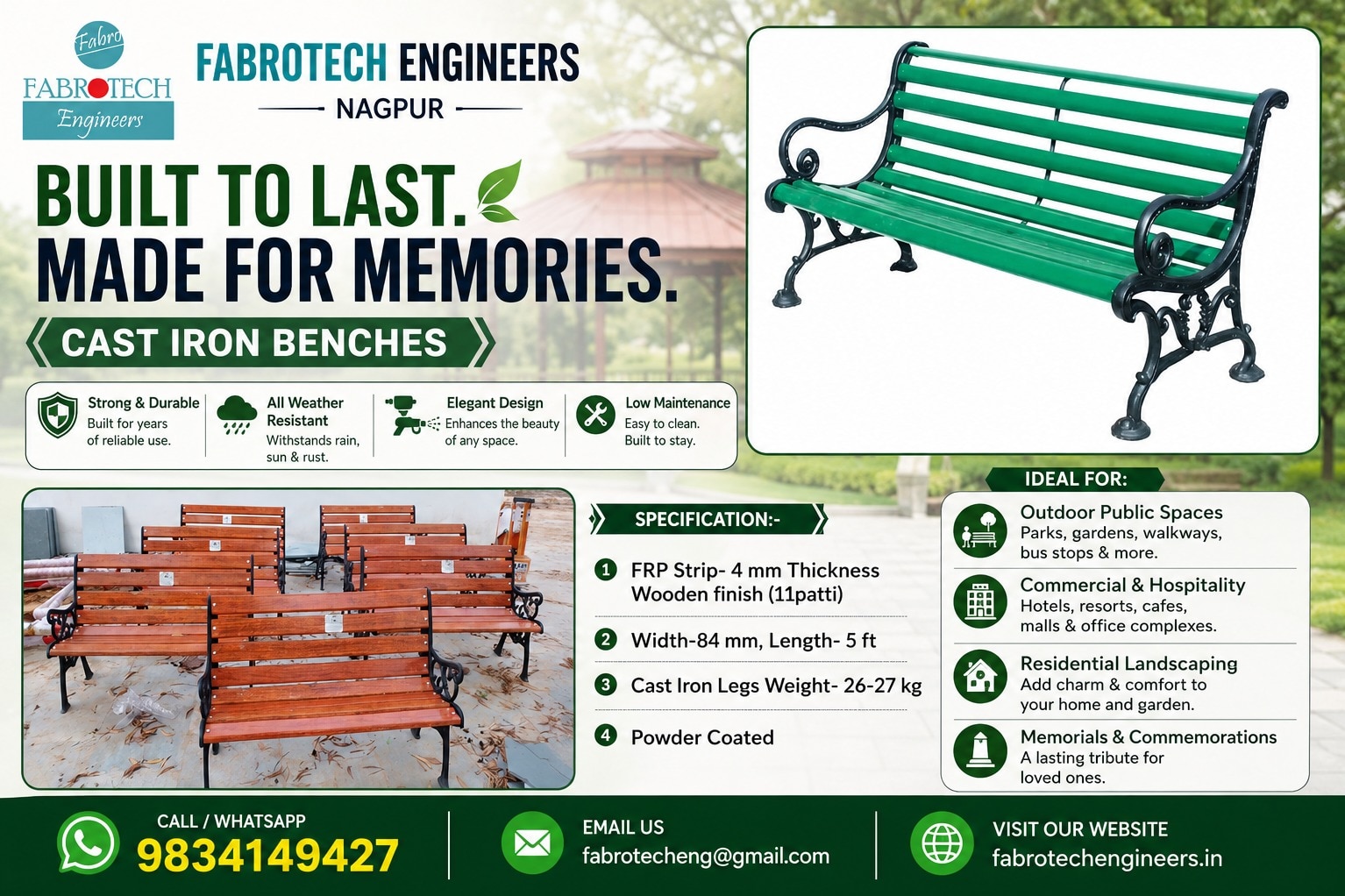
A quoted cast iron bench weight of 26–27 kg is meaningless until you know whether it covers both legs, one leg, or the complete bench. Confirm the packed weight, longest component, lifting points and required vehicle before ordering; a heavy casting resists casual movement but increases loading and installation effort.
Construction choice affects comfort and repair cost:
| Option | Comfort and durability | Repair and handling |
|---|---|---|
| Cast-iron frame with timber slats | Cooler than solid metal in sun; inspect for splitting and rot | Individual boards can be replaced; castings need careful lifting |
| Cast-iron frame with FRP seat strips | Resists moisture and avoids timber decay; still heats in direct sun | Replaceable FRP seat strips reduce whole-bench replacement |
| Cast-iron seat and frame | Very robust but cold in winter and hot in sunlight | A damaged casting is difficult to weld; replacement is usually more predictable |
Ask for a drawing showing slat thickness, spacing, curvature and the attachment method. Check whether the FRP seat strips or timber boards are replaceable individually, rather than bonded into a single unit.
Specify stainless-steel or corrosion-protected bench bolts and washers, the bolt diameter, thread type and whether a tool can reach the fastener without removing the entire seat.
- Confirm drainage around bolt holes and frame-to-slat joints.
- Request spare slats, matching bolts and washers, and the replacement price.
- Reject designs with sealed cavities, inaccessible fasteners or a repair plan based only on field-welding cracked cast iron.
Specify a coating system that survives the site climate
A specification that says “powder coated” is incomplete. Powder coating cast iron demands a documented surface system: degreasing, removal of mould residue and rust, abrasive or chemical pretreatment, primer where required, and a measured final film thickness.
Ask the supplier to state:
- The cleaning and pretreatment method, including how cavities, bolt pockets, ledges and casting edges are prepared
- The coating thickness, adhesion test method, edge coverage and treatment of internal surfaces
- How water drainage is preserved, rather than sealing moisture into a joint or hollow section
- The approved repair method after drilling, impact or transport damage
Use ISO 12944 to classify the site’s atmospheric exposure and select a corrosion-protection system for humid, rainy, polluted, coastal or saline conditions. It helps compare system durability, but it does not certify a particular bench design. Salt spray alone is not proof that water traps and joints will remain sound.
Treat the casting, fasteners and anchors as one corrosion system. Specify compatible metals or isolating washers, protect exposed cut threads, and prevent direct dissimilar-metal contact. Inspect horizontal ledges, feet, slat joints, bolt pockets and drainage paths during outdoor bench maintenance; these locations retain water and start rust beneath the film.
Repair chips before rust spreads under the surrounding coating. Touch-up paint will rarely match the original powder-coat colour, gloss or texture, so record the repair product and accept the visual difference. This is practical cast iron rust prevention, not cosmetic perfection.
Treat anchoring, impact damage and accessibility as design decisions
A heavy frame does not make public bench anchoring safe by itself. Surface mounting transfers crowd and impact forces into the paving, so the connection must suit the actual substrate. Embedded or concealed fixing improves security but complicates replacement; tamper-resistant fasteners cannot rescue weak concrete.
Before approval, require these checks:
- Obtain a fixing drawing showing anchor diameter, embedment, spacing, edge distance, and the substrate specification. Confirm the bench foundation size against the actual soil, footing, slab, or paving—not an assumed site condition.
- Require the published bench load rating and its test basis. Frame weight is not load capacity; ask how the rating addresses concentrated loads, repeated use, and foreseeable misuse.
- Inspect castings after delivery and after impact damage for cracks, chipped sections, distortion, sharp edges, and coating loss. Heavy iron can conceal local section loss while still appearing solid.
- Check slats, bolts, washers, feet, and drainage paths for movement, splitting, protrusion, or blockage. Record repairs and replacement parts instead of waiting for a failure.
For comfortable general-purpose seating, use the 2010 ADA Standards as a defensible reference: seat height of 17–19 inches, seat depth of 20–24 inches, and back support at least 18 inches above the seat. Section 903 addresses dressing, fitting, and locker rooms, not every park bench.
Accessible park seating also needs an accessible route, firm clear ground surface, transfer space where needed, supportive armrests, and distribution across the site. Check local law and the needs of older users or people with reduced mobility before fixing dimensions.
Match the bench to the site and the maintenance team
Specify a cast-iron frame when the bench will stay in one place, face heavy public use, and be managed by a team that can clean, touch up coatings, and replace slats. Its mass discourages casual theft, but it makes relocation and manual handling harder.
| Site condition | Location decision | Maintenance consequence |
|---|---|---|
| Dry, well-drained garden | Use garden bench placement on firm ground, away from irrigation overspray and leaf-filled corners | Fewer water traps and simpler seasonal cleaning |
| Busy park or plaza | Choose a park bench location with clear sightlines, shade where possible, and an accessible route beside it | Staff can inspect damage without closing the area |
| Coastal, salted, or persistently wet site | Specify sealed joints, compatible fasteners, and avoid hollows that retain water | Corrosion checks and coating repairs need shorter intervals |
Keep the seat out of a drainage dip and do not place it where a mower, service vehicle, or falling branch can strike it. Direct sun can make metal seating uncomfortable, so slatted surfaces or shade matter even when the frame is cast iron.
Build cast iron bench inspection into public-space seating maintenance. At each scheduled visit, check ledges, bolt pockets, casting cavities, slat joints, fastener heads, exposed threads, loose anchors, sharp edges, cracked castings, and rust staining. Photograph defects, record their location, and repair coating breaks before moisture reaches the casting.
Ask the supplier, including Fabrotech Engineers, whether damaged slats and end standards are replaceable individually. Replace a cracked casting rather than attempting an uncontrolled field weld; gray cast iron can crack further during repair.
Related product
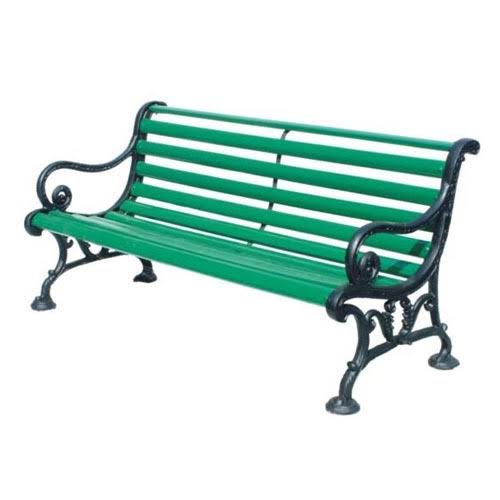 | GARDEN BENCH MANUFATURER ₹6500 1. FRP Strip- 4 mm Thickness Wooden finish (11patti) 2. Width-84 mm, Length- 5 ft 3. Cast Iron Legs Weight- 26-27 kg 4. Powder Coated View product → |
Frequently asked questions
What parts of a cast-iron bench are usually made from cast iron?
Cast iron usually forms the bench’s end standards or legs. The seat and backrest can use timber, recycled plastic, steel or FRP slats.
Which bench materials can be better than cast iron?
Timber offers a traditional appearance, recycled plastic reduces rot concerns, steel can simplify fabrication, and FRP provides low-maintenance slats. The best choice depends on climate, appearance, vandalism risk and maintenance capacity.
What should you confirm before buying a cast-iron bench?
Check the frame material and weight, slat dimensions and material, fixing type, replacement-part availability, anchoring method and access for repairs.
How should a cast-iron bench be protected outdoors?
Specify a coating system suited to the site climate, including protection against moisture, salt exposure and impact damage. Confirm how damaged coating will be repaired.
Why do anchoring and accessibility matter for public benches?
Anchoring limits movement, theft and tipping. Placement and clear space must also support comfortable access for people using wheelchairs, walking aids or adjacent paths.