The right swing depends on who will use it, how children will approach and leave it, and whether the site can accommodate its full movement zone. By the end, you will be able to compare seat types and capacities, measure a safe swing bay, specify surfacing and foundations, and request documentation that supports a practical purchasing decision.
Key takeaways
- Match each seat to the child’s ability, height and weight.
- Separate toddler swings from seats intended for older children.
- Measure swing clearance, fall zones and access routes before ordering.
- Specify surfacing, foundations, records and inspection checks in writing.
Which swing seat suits the children who will use it?
Choose by the child’s ability to enter, remain seated and exit without help—not by the seat’s appearance. Check the manufacturer’s age, height and weight limits, then separate toddler provision from equipment for older children.
| Seat | Best match | Reject or supervise when |
|---|---|---|
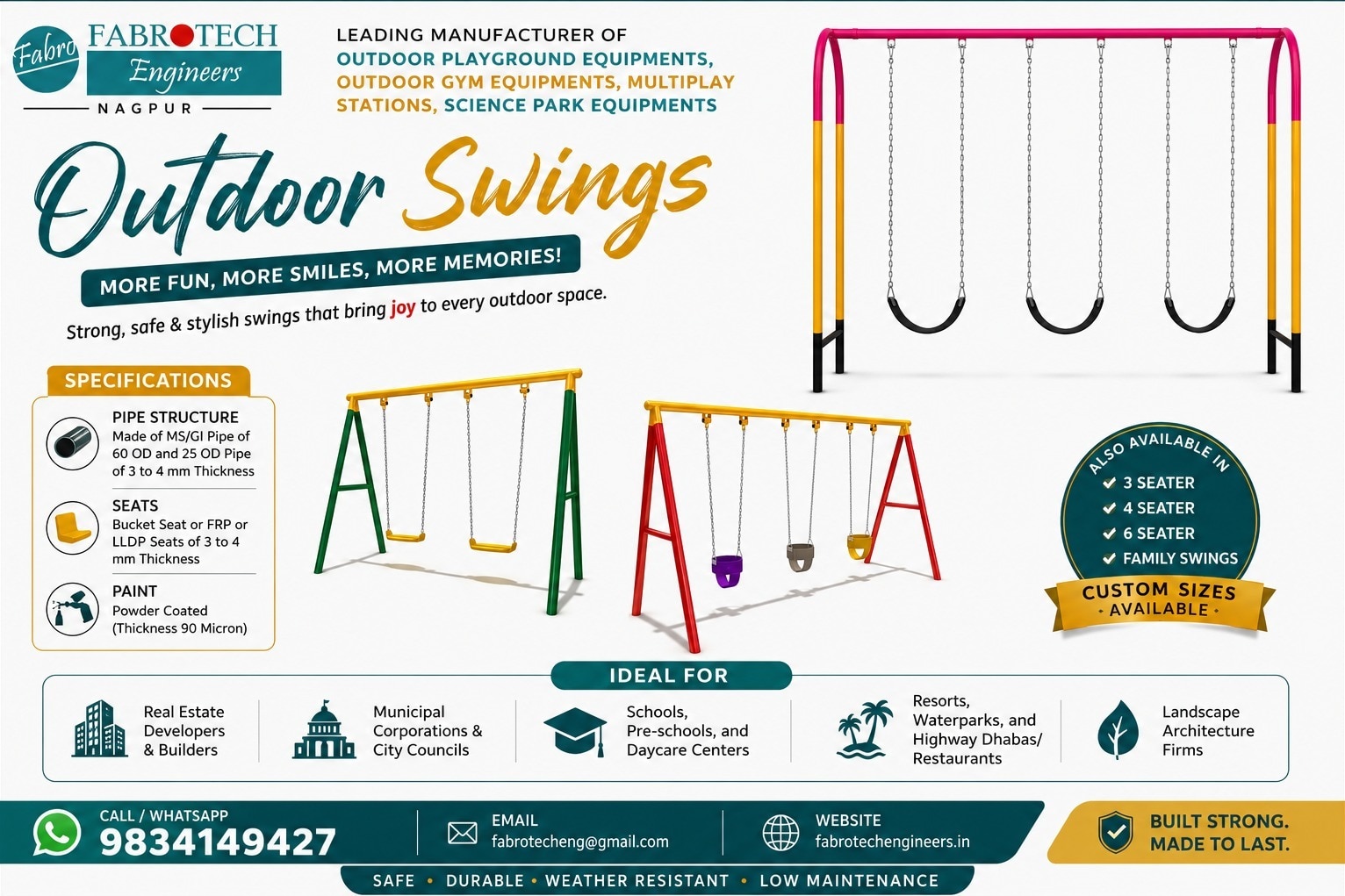
| Bucket seat | Young children within the specified developmental range who need torso support and cannot safely use a flat seat | The child is too large, climbs actively, or cannot exit independently; a full bucket seat can trap the child and complicate supervision |
| Flat seat | Independent riders who can hold on, balance and leave the swing safely | The user needs back or restraint support, or younger children share the bay |
| Arc seat or arc belt seat | Older children who can maintain position; flexible designs reduce the impact of a moving seat compared with heavy rigid seats | The seat is cracked, ultraviolet-damaged or embrittled, or the child cannot grip and sit independently |
| Family-style seat | A manufacturer-rated child-and-caregiver combination, with its stated passenger number and total load | Users stand, change places or exceed the rating; a family swing is not two independent belt swings |
Ask for replaceable-seat availability and inspect flexible seats for tears, exposed hardware and loss of resilience. “Arc belt seatings” in a catalogue needs clarification: confirm the exact seat type, user limits and safety instructions. Provide close supervision for children needing transfers, posture support or communication assistance; the word accessible alone proves nothing.
How many seats does the site and daily demand require?
Choose capacity from the busiest 15-minute period, not the site’s total daily attendance. Count children who will want to swing at the same time, then add space for waiting, supervision and safe circulation; more seats do not help if the use zones overlap.
| Option | Best fit | Main limitation |
|---|---|---|
| two-seater swing | Small parks, low-demand courtyards and supervised school groups | Queues grow quickly at peak play times |
| four-seater swing | Sites with regular class breaks or moderate daily traffic | Needs a wider bay and more separation between moving seats |
| six-seater swing | High-demand parks with enough land for circulation | Concentrated movement increases supervision and queue-management demands |
| family swing | Parent-child use, inclusive group play and shared seating | Capacity depends on the manufacturer’s load rating and behaviour, not the number of bodies alone |
Base the order on simultaneous demand: a two-seater swing suits a quiet site, while a six-seater swing suits a busy site only when its full use zone fits without blocking paths. A four-seater swing often balances queue length and land use.
Do not treat a family swing or boat-style two-person swing as two independent seats. Check its rated users, total load, motion pattern and supervision assumptions. Keep at least 24 inches between adjacent swings and 30 inches from a swing to its supporting structure at the closest point during movement.
Front and rear clearance must extend at least twice the pivot height; a 10-foot pivot needs 20 feet in each direction. If that area cannot fit, reduce capacity or relocate the equipment.
How much space must you measure around a swing?
A swing with a 10-foot pivot point needs a 20-foot front-and-rear swing use zone, measured over protective surfacing—not the six-foot perimeter used for many static structures. That dimension can dictate the entire bay and circulation route.
1. Measure from the pivot point to the protective surface below. Use that height to set the fall zone and surfacing requirement; measuring from the seat understates the impact height.
2. Draw the swing travel clearance twice the pivot height in front and behind the frame. Extend the plan across the full seat width, then add lateral clearance: at least 24 inches between adjacent swings and 30 inches between a swing and its support structure.
3. Check every dimension with the seat moving, not only at rest. Identify walls, fences, trees, posts, benches, kerbs, lighting, drainage covers and other equipment that could enter the swing use zone.
4. Measure overhead clearance above the highest point reached by the seat, chains and any occupant. Check branches, roof edges, cables and light fittings, and keep the accessible route outside the fall zone.
Mark the route from the entrance to the swing, including turning space and a firm, stable, slip-resistant surface. If the measured bay cannot preserve these clearances, relocate the equipment or choose a different design before requesting a quotation.
Which surfacing and foundation details protect the installation?
Select surfacing by the swing’s actual fall height, measured from the pivot point to the protective surface, not from the seat underside. A high beam still demands high-performance surfacing beneath a low seat. Name ASTM F1292 or EN 1177, according to the project jurisdiction, and require test data for that fall height.
| Surface | Strength | Site decision |
|---|---|---|
| Engineered wood fibre | Impact attenuation depends on installed depth and regular replenishment | Use where staff can rake displaced material and inspect for hidden objects |
| Loose-fill rubber | Loose particles shift from takeoff and landing paths | Specify depth checks, raking and top-ups; do not rely on initial depth alone |
| Poured-in-place rubber | Continuous surface, but seams, slope and installation affect access | Use where accessible routes need firm, stable, slip-resistant travel |
| Grass playground surface | Natural cover is not a substitute for tested impact protection at a high fall height | Use only where the tested surface and site conditions satisfy the governing requirement |
Treat impact attenuation and accessibility as separate approvals. A rubber surface can pass ASTM F1292 yet fail accessibility through raised seams, excessive slope, poor drainage or openings.
Specify foundations for the actual soil, groundwater, frost movement, utilities and anticipated loads. Require an engineer or manufacturer to state footing dimensions, concrete strength, reinforcement, anchor depth and corrosion protection; never bury posts in standing water.
Grade drainage away from foundations, prevent ponding at surfacing edges, and verify post plumb, settlement and lateral movement after installation. Conceal or protect concrete so it cannot become an impact hazard.
What should your purchase specification and inspection file include?
Approve an outdoor swing only when the supplier’s file identifies its safety features, governing standard, test evidence and replacement parts. Do not accept “safe” or “accessible” as specifications.
- Require a signed conformity declaration naming the edition of ASTM F1487 or EN 1176-2, plus drawings showing swing travel, clearances, pinch-point protection and anti-wrap design.
- Specify a fully closed swing chain or swing cable, sealed hanger bearings, covered connectors, non-protruding hardware and S-hooks closed against clothing entrapment.
- Record the seat restraints advantages claimed, the intended user range, and the transfer, approach and manoeuvring conditions for any accessible seat.
- Obtain a documented inspection method covering the complete seat-and-chain assembly, hidden hardware, corrosion, cracks, ultraviolet damage and cold-weather embrittlement.
| Standard | Obtain in writing | What it covers |
|---|---|---|
| ASTM F1487 | Conformity declaration and test report | US public-playground equipment |
| ASTM F1292 | Surfacing test report stating critical fall height | Impact attenuation in US projects |
| EN 1176 | Conformity evidence, including EN 1176-2 for swings | European playground equipment |
| EN 1177 | Surfacing test report and critical-fall-height rating | European impact-attenuating surfacing |
The file must name replaceable swing chain, swing cable, seats, hanger bearings, connectors and surfacing components, with part numbers, prices or quotation validity, lead times and replacement instructions. Require access without dismantling the main frame. For a supplier such as Fabrotech Engineers, make those documents part of the purchase order, not a verbal promise.
Related products
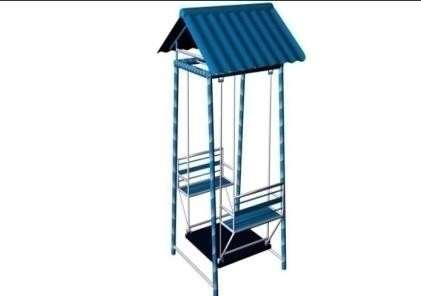 | PLAYGROUND EQUIPMENT MANUFACTURER ₹21500 Area : 1.5 M X 1.5 M Height : 2.0 M Accessories : 8 Nos. Gazan Pin For Moving Support Seating Capacity : 4 Seater Pipe- structure made of MS Pipe OF... View product → |
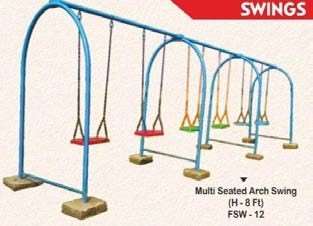 | PLAYGROUND EQUIPMENT MANUFACTURER ₹21500 Specification Main structure- Pipe- structure made of MS Pipe OF 60 od and 25 od pipe OF 3 to 4 mm thickness Seats- structure made of FRP pata OF 3... View product → |
Frequently asked questions
Which swing seat suits the children who will use it?
Choose a seat that lets each child enter, remain seated and exit without help. Check the manufacturer’s age, height and weight limits, and provide separate toddler equipment for younger children.
How many swing seats does the site and daily demand require?
Base the number of seats on the expected daily users, peak arrival periods, age groups and available footprint. Separate toddler and older-child provision so one queue does not serve incompatible users.
How much space must you measure around a swing?
Measure the complete footprint, the travel path in front of and behind each seat, side clearances, fall zones, access routes and space between adjacent equipment. Use the manufacturer’s installation drawing and the applicable safety standard for final dimensions.
Which surfacing and foundation details protect the installation?
Specify impact-attenuating surfacing across the required fall zone, install it to the manufacturer’s depth and maintain drainage. Confirm foundation dimensions, concrete details, anchor positions and finished-ground levels before installation.
What should your purchase specification and inspection file include?
Record seat type, user limits, frame and hardware specifications, clearances, surfacing, foundation drawings, installation instructions, maintenance intervals, inspection results, repairs and the equipment’s identification details.
Related products
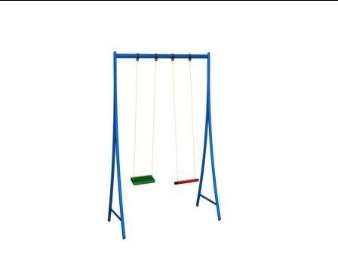 | PLAYGROUND EQUIPMENT MANUFACTURER ₹13499 Pipe- structure made of MS Pipe OF 60 od and 25 od pipe OF 3 to 4 mm thickness Seats- structure made of FRP pata OF 3 TO 4 mm Thickness. View product → |
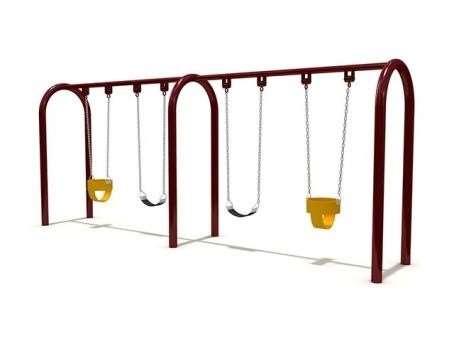 | PLAYGROUND EQUIPMENT MANUFACTURER ₹21500 Pipe- structure made of MS Pipe OF 60 od and 25 od pipe OF 3 to 4 mm thickness Seats- structure made of Bucket seat and Arc Belt OF 3 TO 4 mm... View product → |