A bin in a mall, school, transit area or park must survive impacts, rain, residue, repeated emptying and constant public contact without creating an obstruction. By the end, you will be able to compare HDPE with other materials, specify the construction details that matter, choose the right capacity and placement, and decide when another material is safer.
Key takeaways
- Choose impact-resistant HDPE for bins exposed to knocks, dragging and frequent washing.
- Match capacity to footfall, collection frequency and the waste volume generated.
- Use covered lids where rain, animals or odour control creates a problem.
- Prevent early damage by avoiding overloading and separating incompatible waste.
Why HDPE Handles Daily Public-Space Abuse
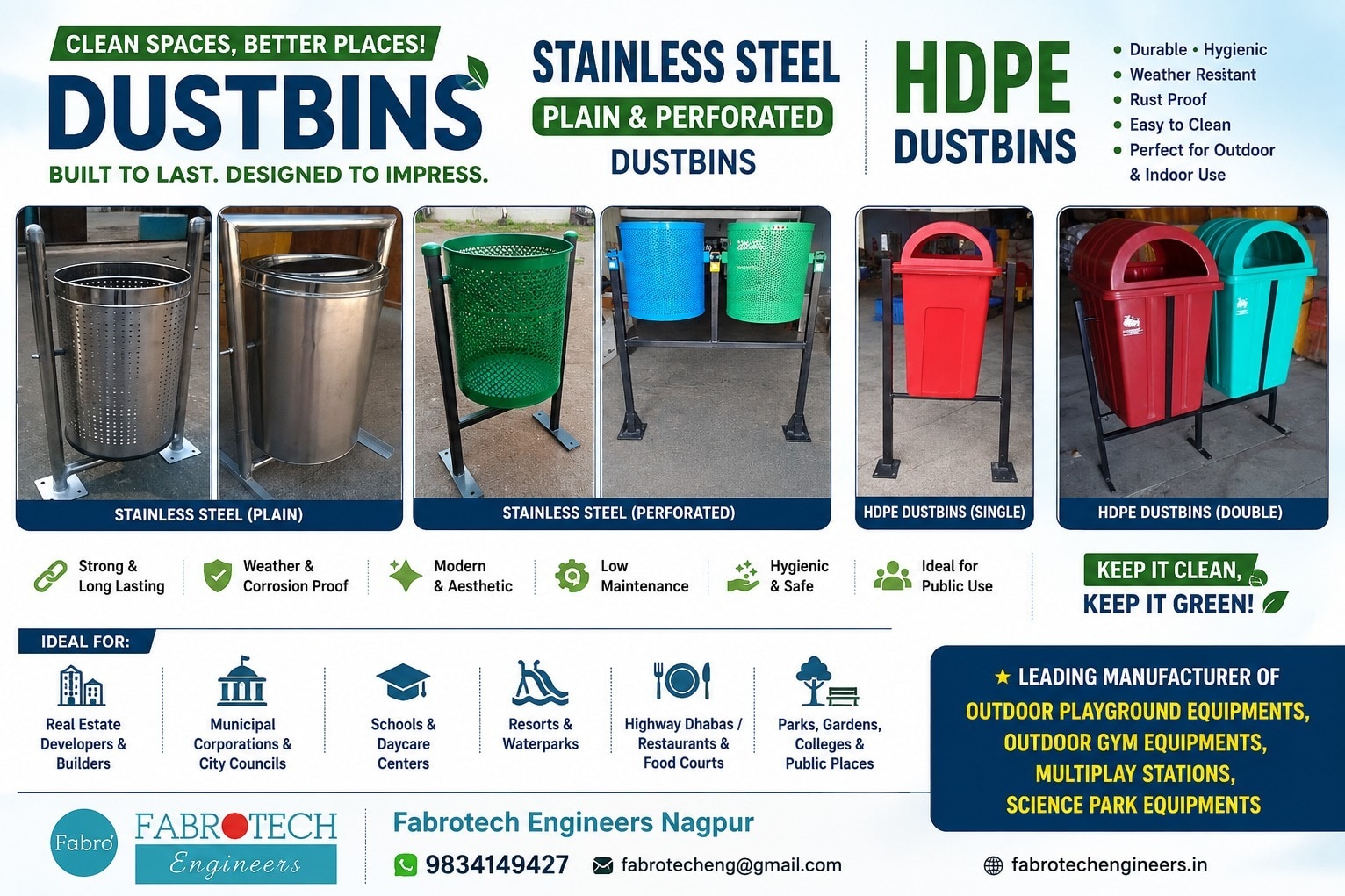
A busy public area needs a bin that survives knocks, dragging, repeated emptying and routine washing without becoming a repair task. HDPE dustbins suit this work because their impact resistance helps absorb everyday blows without denting like thin steel or cracking like some rigid FRP products.
Moisture resistance is another advantage. Typical HDPE grades absorb about 0.01% water after 24 hours under ASTM D570, so rain, washing and freeze–thaw cycles cause little swelling or dimensional change. Standing water still carries dirt and microbes, so drainage and cleaning remain essential.
HDPE also tolerates dilute acids, alkalis, salts, detergents and many water-based cleaning chemicals found in ordinary waste areas. For the chemical resistance of HDPE dustbins, standards such as EN 840-5 do not replace a compatibility check: strong oxidising acids, hydrocarbons and chlorinated solvents can swell or crack the plastic.
- Choose UV-stabilised HDPE for outdoor placement; ask for the stabilisation system and weathering evidence, such as ISO 4892-2 testing.
- Treat fire performance separately: standard HDPE is combustible, and waste contents can intensify a fire near buildings, escape routes or playgrounds.
- Check the EN 840 series when specifying mobile wheeled containers; fixed litter bins do not automatically fall under every part.
Compared with stainless steel, HDPE avoids corrosion and reduces dent visibility, while remaining easier to clean and replace than a cracked composite shell. It does not eliminate odours, staining or sun ageing, but its practical maintenance burden stays manageable when the grade and construction match the site.
What to Compare Before You Specify the Bin
A durable bin starts with controlled construction, not the word HDPE alone. Ask for virgin HDPE when impact consistency and outdoor service matter, plus the minimum wall thickness at the body, corners, base and mounting points.
Rotational moulding can create a one-piece shell without welded seams, but thin areas still develop around ribs, hinges and drainage holes.
Compare HDPE vs stainless steel dustbins and HDPE vs FRP dustbins against the same site conditions:
| Material | Advantages | Check before specifying |
|---|---|---|
| HDPE | Resists dents, moisture, household-waste chemicals and routine impacts; easy to wash | Confirm wall thickness, moulded ribs, a reinforced rim and rounded corners |
| Stainless steel | Rigid, non-porous and less vulnerable to surface scratching | Check grade, weld quality and corrosion protection; salt, cleaners and standing water can stain or corrode it |
| FRP | Stiff and resistant to many chemicals | Inspect for cracking, fibre exposure and UV degradation; repairs can be less straightforward than replacing an HDPE panel |
For outdoor placement, require UV stabilisation and ask which exposure the formulation targets. A supplier that cites accelerated weathering to ISO 4892-2 provides stronger evidence than a generic “outdoor grade” claim. For recycled HDPE dustbins, request the recycled-content source, controlled grade and impact or weathering test data; recycled content alone proves nothing about durability.
Check EN 840 where its dimensional and functional requirements apply. Specify wheel diameter, tread, axle, bearing, brake and rated load, because casters often fail before the shell. Leave hinge and lid clearances for HDPE’s thermal movement, especially on dark bins in direct sun.
How to Choose Capacity, Lid Type and Placement
Start with measured demand, not the largest available container. For a dustbin capacity calculation, multiply the waste generated between collections by the collection interval, then add 20–30% free space.
A 60-litre bin beside a quiet office entrance may suit the site; the same bin near a food court queue could overflow before the next service round.
Choose the operating design against the waste and user behaviour:
| Design | Best use | Main trade-off |
|---|---|---|
| Open-top dustbin | Dry litter where fast disposal matters | Exposes waste to rain, wind and animals |
| Swing-lid dustbin | General public areas needing a covered HDPE dustbin | Touch points collect grime and restrict oversized waste |
| Flap-lid dustbin | Controlled openings in malls, stations and food areas | Flaps need clearance and regular hinge cleaning |
| Pedal-operated dustbin | Sites demanding hands-free access | Pedals and mechanisms need protection from impact and water |
Place bins on the natural path of travel: at entrances, exits, seating areas, food-service points and queue ends. Keep them outside door swings and emergency routes, on a level surface with drainage, and close enough that users do not abandon waste nearby. Anchor units where crowd movement, wind or theft is a concern.
For waste segregation colour coding, use clearly labelled, consistently coloured bins with openings shaped for the intended waste. Match each capacity to the busiest stream; a small residual-waste bin beside a large food-waste bin will still overflow first.
How to Prevent Overloading, Contamination and Early Damage
Empty the bin before waste reaches the lid or compacts around the liner. Overloading strains lid hinges, lifting points and wheels, while sharp or heavy items can puncture the liner and damage the HDPE base.
1. Fit the correct liner size, leaving enough material to fold over the rim without blocking the lid. Separate glass, hot ash, liquids, chemicals and medical waste instead of placing them in a general-use bin.
2. Follow posted dustbin cleaning instructions: remove the liner, hose or wipe the interior, clean the lid underside, hinges, pedal recesses, drain points and wheel guards, then allow trapped water to drain. HDPE does not absorb much water, but residue left on its surface still produces odour and contamination.
3. Apply a public-space waste bins inspection checklist at each collection round. Check the dustbin wheels, feet, lid fasteners, rim, base, handles and mounting points for cracks, looseness, seized casters, missing hardware and sharp edges.
4. Tighten or replace failed hardware before returning the unit to service. Replace a wheel, axle, lid or liner-retaining part rather than dragging a damaged bin, which can deform the base and create a trip hazard.
Record recurring overflow, leakage or vandalism by location and collection time. Adjust collection frequency, capacity or placement when the same problem repeats; cleaning alone will not solve a bin that is consistently overloaded.
When HDPE Is the Practical Choice—and When It Is Not
Choose HDPE when the site needs a washable, impact-tolerant body and the waste is ordinary household or commercial refuse. Its HDPE dustbin lifecycle cost depends less on the shell alone than on UV stabilisation, wheel quality, lid hinges and access to replacement parts.
Specify UV-stabilised HDPE for outdoor exposure, and verify the cleaning chemicals, concentration and temperature. Strong oxidising acids, hydrocarbons, aromatic solvents and chlorinated solvents can swell or crack it.
Use a separate stability specification for crowded routes, playgrounds and open grounds. EN 840 compliance does not prove tip resistance: confirm base footprint, centre of gravity, fill height, wheel position and wind stability. A weighted base dustbin anchoring arrangement can help, but check that anchors do not create trip points or block maintenance access.
- Select HDPE when the body’s low corrosion, easy cleaning and replaceability outweigh the need for fire performance or extreme security.
- Reject a light unit for exposed sites if casters, brakes or the base cannot handle the filled load; undersized hardware often fails before the plastic.
- Specify fire-rated dustbins for high-temperature waste, building entrances or escape routes. Standard HDPE is combustible.
- Consider stainless steel or reinforced alternatives where severe vandalism resistance, hot ash or solvent contamination matters more than low handling weight.
Fabrotech Engineers can be asked to document resin type, UV stabilisation, caster rating, anchor method and replacement hardware before you compare a proposed model on purchase price alone.
Frequently asked questions
Why is HDPE suitable for high-traffic public areas?
HDPE resists everyday impacts, repeated handling and routine washing without denting like thin steel or cracking like some rigid FRP products.
What should you compare before specifying an HDPE dustbin?
Compare wall thickness, UV resistance, handles, hinges, wheels, lid fit, drainage, cleaning access and the manufacturer’s load guidance.
How do you choose HDPE dustbin capacity and lid type?
Base capacity on footfall, waste generation and collection frequency. Choose an open top for quick disposal, or a covered lid for rain, animals and odour control.
How can you prevent overloading and early damage?
Set collection intervals, keep the fill line visible, separate unsuitable waste and avoid dragging a full bin by its lid or handles.
When is HDPE not the practical choice?
Choose another material when you need high-temperature waste handling, specialised chemical resistance, fire-rated construction or resistance to deliberate vandalism beyond normal public-space use.