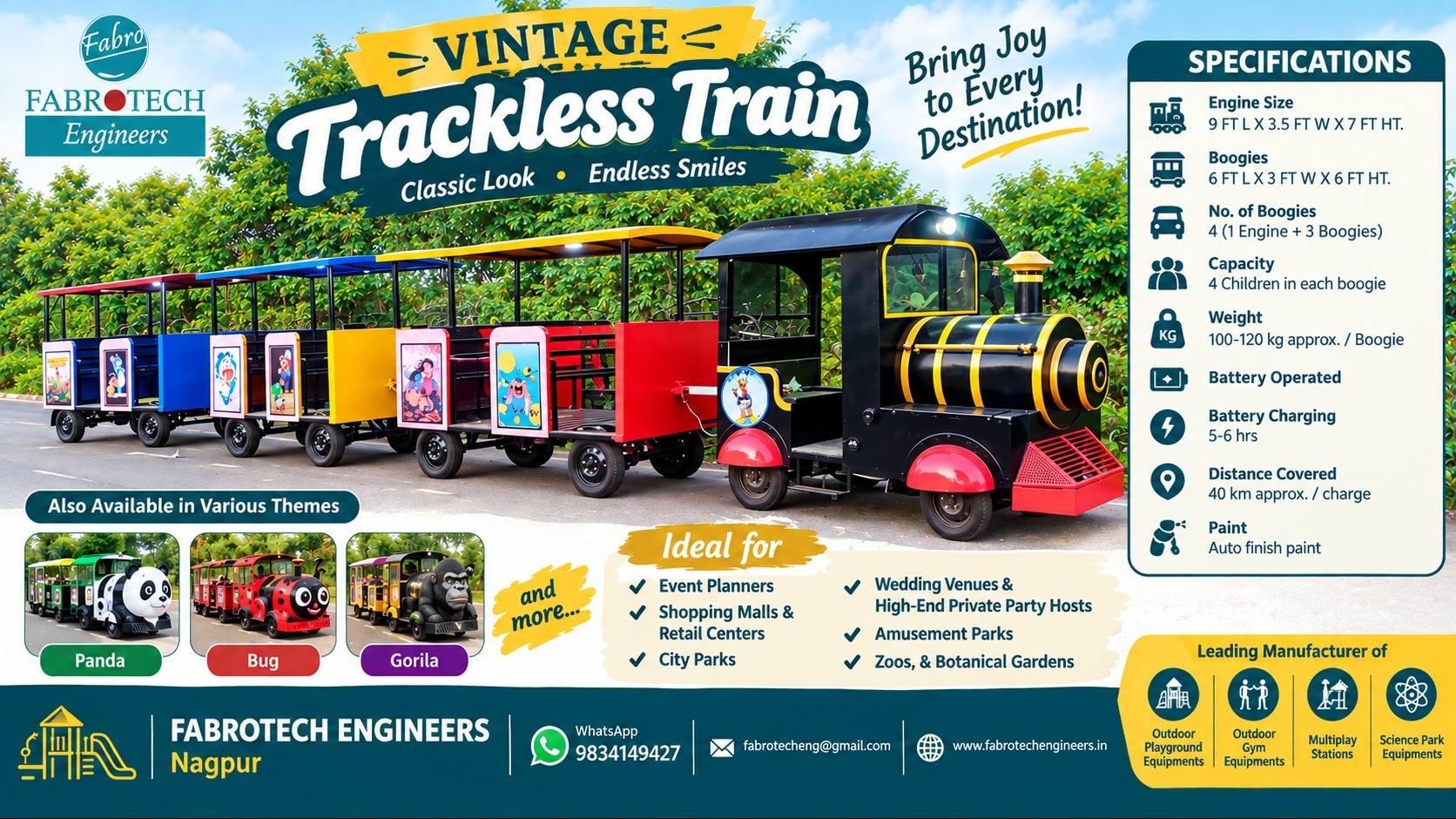
A trackless train succeeds when its route, operating cycle and passenger experience are designed together—not when a vehicle is simply placed on an existing path. By the end, you will be able to test whether the attraction fits your site, estimate realistic throughput and identify the operating documents and commissioning evidence to request.
Key takeaways
- Design stops and scenery so the train feels like an attraction, not only transport.
- Calculate capacity from coach loading, dwell time, route length and operating hours.
- Match the train format to paved access, visitor flow and the site’s available space.
- Require safety files, maintenance records, operator training and supplier documentation before purchase.
What makes a trackless train an attraction rather than just a shuttle?
A trackless train uses a powered tractor or vehicle to pull passenger coaches along a defined paved route without embedded rails. It transports guests, but a trackless ride becomes a park attraction when the journey itself offers reasons to look, listen and stop.
That experience can combine landscaped scenery, narration, themed stops and planned viewpoints. Photo opportunities and frequent boarding improve engagement, but each stop adds dwell time and reduces transport throughput. A shuttle versus attraction train decision therefore depends on whether guests value the journey more than fast point-to-point movement.
Route behaviour determines whether the ride feels polished or awkward. Coaches cut inside a turn, while the rear of an articulated train can swing outward, so approval must use the complete train’s swept path at its tightest turn, not the locomotive’s centreline.
Test ride comfort, speed control, noise, vibration, braking and driver sightlines around curves, crossings and parked vehicles.
A moving attraction earns its space when it reveals scenes that walking misses, connects distant themed areas or provides a gentler alternative to active play. A carousel delivers a concentrated cycle, a fixed playground ride offers hands-on activity, and a walking route gives guests control over pace.
Choose the train when guided movement and changing views create more value than a stationary experience; choose a shuttle when speed, capacity and predictable arrivals matter most.
How should the route and daily operating cycle be designed?
Design the route around the full train, not the tractor. Trackless train route planning must show the minimum turning radius, complete swept path and a continuous operating envelope. Use barriers, marked crossings and controlled pedestrian separation; a painted centreline is not enough.
- Confirm route width through curves, boarding areas and narrow approaches.
- Measure clearance from columns, walls, trees, landscaping and queue barriers.
- Test gradients, drainage and braking on wet, muddy or contaminated paving.
- Keep emergency-access routes open, including when the train is stopped.
- Define crossings, exclusion zones and pedestrian controls at every conflict point.
- Remove temporary event equipment and control service vehicles before dispatch.
At the station, load passengers through a queue that leaves the emergency route clear. Provide level accessible boarding, transfer space and a procedure for mobility aids. Before dispatch, the driver checks restraints, handrails, steps, gates, mirrors, alarms and passenger seating, then moves at a controlled speed. Stop only at planned locations.
Turn without entering the pedestrian zone, and reverse only inside a marked exclusion zone with a trained spotter when visibility is restricted; cameras and alarms do not replace the spotter. Return passengers to the station before shutdown, then isolate power, inspect damage, remove debris and record faults.
For battery-electric trains, place charging where cables cannot cross guest routes and allow the documented charging time between operating blocks. Plan a charged spare vehicle or recovery vehicle, define thermal-event isolation and fire-response procedures, and derate the timetable for reduced cold-weather range or hot-weather battery protection.
Include a safe egress point if the train stops away from the station.
How much passenger capacity can the attraction actually deliver?
Calculate trackless train capacity as: passenger seats per coach × number of coaches × completed dispatches per hour. Four coaches with 20 seats each and six completed dispatches produce a theoretical 480 passengers per hour before operational losses.
Dispatch time is the interval between one departure and the next. Measure it from:
- Queue loading and accessible boarding
- Child supervision and mobility assistance
- Restraint or handrail checks
- Driver checks and dispatch clearance
- Unloading at the station
- Recovery from a late departure
Ride duration is not dispatch time. A 10-minute route can still deliver low ride throughput if boarding, unloading and checks keep the station occupied for 15 minutes. Scenic stops, narration and photo opportunities add dwell time rather than passenger movement.
Reduce the forecast for weather interruptions, minor faults and scheduled recovery time. Include queue capacity planning: compare expected arrivals during the busiest period with actual passengers per hour, then provide enough holding space for the difference without blocking crossings or emergency access.
Validate the forecast with observed full-load cycles, not advertised seat count. Run repeated stop-start operation with child supervision, mobility assistance and normal unloading, then measure completed dispatches during the busiest expected arrival period. Record delays from scenic stops, narration, weather and late departures; the result is your usable capacity, not the brochure maximum.
Which sites and ride formats are a good fit?
A trackless train site suitability test starts with the route, not the vehicle. An indoor mall train needs a wide, predictable floor, protected pedestrian crossings and turning space; an outdoor park ride needs drainage, durable paving and separation from cyclists, service vehicles and crowds.
| Format | Best fit | Main limitation |
|---|---|---|
| Trackless train | Scenic parks, malls and mixed pedestrian routes with controlled crossings | Full train swept path needs space around turns, ramps and queues |
| Tram-style vehicle | Frequent, direct movement on broad paved promenades | Less suitable for tight turns and themed stops |
| Shuttle cart | Short point-to-point trips and low-demand links | Offers less scenery and passenger capacity |
| Miniature railway | Dedicated route where rail construction and crossings are acceptable | Cannot easily change route around events or repairs |
| Carousel | Compact, stationary entertainment zone | Does not transport guests between scenes |
| Walking attraction | Narrow paths, gardens and routes needing maximum flexibility | Depends on guest mobility, weather and walking distance |
| Fixed playground ride | Active play in a defined footprint | Does not provide transport or continuous scenery |
Inspect every curve from the driver’s eye level. Vegetation, parked vehicles, queue barriers and crossings can hide guests or reveal an attractive scene only after the train has passed. Test narrow corridors, ramps, uneven or wet surfaces and high-traffic public spaces with a fully loaded train.
Plan accessible boarding at an accessible route to at least one load and unload area where required. Provide a level boarding interface, turning and transfer space, mobility-device storage or securement, and a procedure that does not make an accessible guest wait for an exceptional cycle.
What safety and procurement evidence should you require?
Require a trackless train safety checklist backed by documents, drawings and witnessed tests—not a brochure that says “safe” or “safety-tested.” Ask the supplier to identify what was assessed, by whom, when and under which standard.
1. Collect the passenger and vehicle file: restraint policy; handrail and step-height dimensions; door or gate drawings; anti-pinch protection; service and emergency braking data; horn, lights, mirrors and fire equipment specifications; driver-training records; and an evacuation procedure for a train stopped away from the station.
It must cover passenger communication, responder access, disabled-train recovery and a blocked pedestrian or emergency route.
2. Separate the evidence by purpose. ASTM F2291 supports design evidence for the ride and its operating envelope. ASTM F770 covers owner and operator procedures for operation, inspection, maintenance and training. ASTM F1193 covers manufacturing, construction and quality records. Do not accept one certificate as proof of all three.
3. Require route-specific commissioning results at maximum passenger load, including acceleration and braking, repeated stop-start cycles, tight turns, emergency stops, mobility-aid boarding, pedestrian-crossing control and operation on wet or partially obstructed surfaces. Record stopping distances, restart performance and any operating limits.
Compare Fabrotech Engineers with other manufacturers only after reviewing these records alongside commissioning support, maintenance instructions, charging or refuelling arrangements and the proposed operating plan as one complete system.
Related products
 | MALL TRACKLESS TRAIN MANUFACTURER Vintage Train – Classic Amusement Ride Experience ₹450000 The Vintage Train by Fabrotech Engineers is a beautifully crafted amusement ride that brings classic charm and joyful entertainment to parks, malls,... View product → |
 | MALL TRACKLESS TRAIN MANUFACTURER Bug Train – Fun Ride for Kids & Parks The Bug Train by Fabrotech Engineers is a colorful and engaging amusement ride designed to provide safe entertainment for children in parks,... View product → |
Frequently asked questions
What makes a trackless train an attraction rather than just a shuttle?
A defined theme, visible points of interest, planned stops, commentary, lighting or interactive features give passengers reasons to experience the journey rather than simply reach a destination.
How should a trackless train route and daily operating cycle be designed?
Map a paved route with safe turning space, accessible boarding areas, sightlines and controlled crossings. Set departure intervals, stop durations, loading procedures, breaks, inspections and weather contingencies before opening.
How much passenger capacity can a trackless train actually deliver?
Estimate output from seats per departure, loading time, dwell time, route duration and operating hours. Reduce the theoretical total for boarding assistance, pauses, unloading and scheduled breaks.
What safety and procurement evidence should you require?
Request vehicle specifications, braking and steering details, load limits, risk assessments, inspection schedules, maintenance instructions, operator training records, spare-parts support and compliance documents.