
Students learn more from an outdoor installation when they predict an outcome, change one condition, observe what happens and defend an explanation with evidence. By the end, you will be able to plan station activities, select equipment for your site, and judge whether an installation is educationally useful, safe, inclusive and manageable to operate.
Key takeaways
- Require students to change one variable and record a measurable result.
- Use observation sheets to connect movement with predictions, evidence and explanations.
- Group stations around one concept instead of choosing unrelated activities.
- Check accessibility, fall zones, drainage, materials and maintenance before purchase.
What Students Actually Do at an Interactive Science Station
A station becomes an investigation when students must change something and support an explanation with evidence, rather than simply look at a model. The activity links prediction and observation to a question with a measurable result.
- Predict what will happen before touching the equipment.
- Change one factor, such as load, distance, angle or surface.
- Carry out hands-on testing and observe the result.
- Record a number, position, time or visible change.
- Compare results with another trial and explain the pattern to a partner.
A pulley station can ask whether adding mass changes movement, building force and motion understanding for primary and lower-secondary students. A balance can turn centre of gravity and equilibrium into a test: students place objects at different distances, predict which side will drop, then defend the result using a simple diagram.
Magnetism and optics demonstrations work the same way. Students predict which objects a magnet will attract or where a reflected beam will appear, operate the apparatus, and check the prediction against what they see.
The question matters more than the apparatus: “What changed when you moved the magnet?” produces better reasoning than “Did you enjoy it?”
Outdoor conditions add useful evidence. Students can repeat a sundial, wind or sound investigation at different times, recording weather or background noise so they do not mistake changing conditions for a scientific law. A station earns its place when every visitor leaves with a result to compare, an explanation to revise and evidence to share.
How Teachers Turn Movement and Observation into Evidence
A 20-minute investigation should move from prediction to physical testing, measurement, explanation and classroom modelling. Students need to do more than operate a sundial, pulley or balance; they must connect a changed condition with an observed result.
1. Give groups of three or four one question, such as “How does ramp angle affect travel distance?” Students record a prediction on measurement sheets before touching the equipment.
2. Assign one variable to change and one result to measure. At a balance station, students alter the load position and record the distance from the pivot when the beam tips. The teacher asks, “What stayed the same, and what changed?”
3. Use group size and station rotation deliberately. Groups spend six minutes testing, two minutes recording, then rotate to a related station that changes the evidence, such as comparing a pulley’s effort with a lever’s effort.
4. Require peer explanation before giving the scientific term. One student describes the observation, another points to the measurement, and a third explains the pattern. Ask, “What evidence supports your claim?”
5. Close outdoors with a classroom transfer. Students draw a force diagram, ray diagram or scale model and explain which observation it represents and which detail the model leaves out.
This sequence makes the NGSS science-and-engineering practices visible: asking questions, planning investigations, analyzing data, using mathematics, constructing explanations and arguing from evidence. A teacher can assess the explanation, not just whether students operated the equipment.
How to Choose a Coherent Set of Stations for Your Site
Choose the learning route by matching the investigation, not the novelty, to your students’ next question. Run a classroom apparatus comparison: identify which option lets students predict, manipulate variables, measure results and argue from evidence, then check whether it fits your progressive learning route.
| Option | What it provides | Main limitation | Choose it when |
|---|---|---|---|
| Outdoor science equipment | Repeated, full-body investigation with real scale, motion and peer observation | Weather exposure, supervision and fixed location constrain use | Students need physical experience of forces, balance, scale or structures |
| Classroom apparatus | Controlled variables, precise measurements and easy teacher intervention | Small groups and limited equipment can restrict access | Students need accurate testing after an outdoor observation |
| Digital simulation | Rapid changes to invisible variables, models and extreme conditions | Screens remove physical resistance, scale and embodied spatial judgement | Students need to test scenarios that are unsafe, expensive or impossible outdoors |
| Mobile kit | Hands-on investigation at different schools or locations | Setup, missing parts and transport consume teaching time | The programme requires portability or temporary deployment |
| Museum exhibit | Curated explanation and high visitor appeal | Short visits discourage repeated trials and data collection | Students need orientation, context or a memorable demonstration |
Map stations to age-appropriate practices such as asking questions, planning tests, analysing data and explaining evidence. Then test the site footprint and visitor throughput: a precise station that serves two pupils per minute may fail a class rotation.
Assess weather exposure and portability together; choose fixed equipment for repeated local use, and mobile kits for changing venues. Reject any station whose physical invitation encourages climbing, swinging or crowding without a defined learning purpose and risk review.
How Safety, Access and Maintenance Shape the Learning Experience
Students use outdoor science equipment confidently only when the site makes safe investigation easier than unsafe improvisation. Check the ground, movement paths, weather exposure, access routes and supervision plan before asking students to climb, turn, pull, balance or run.
1. Map foreseeable misuse, not only the intended experiment. Include simultaneous users, wet surfaces, loose objects, entanglement, entrapment, pinch points, falls and impact with nearby structures. Define fall zones and impact-attenuating surfacing around elevated or moving elements; ASTM F1292 impact performance does not prove that a surface is firm or stable enough for wheelchair travel.
2. Classify each installation before choosing a standard. ASTM F1487 addresses public-use playground equipment, while ASTM F3101 addresses outdoor fitness equipment. A station combining climbing, spinning, resistance or exercise needs a deliberate risk review, age-appropriate instructions and clear separation between moving parts and bystanders.
3. Test accessibility and inclusive interaction as part of the lesson. Provide routes with manageable slopes, firm surfaces and no abrupt level changes, then add high-contrast graphics, tactile markings, audible or vibration cues, and controls reachable from standing and seated positions. Several students should be able to observe or operate the same phenomenon together.
4. Plan for weather and deterioration. Shade, drainage, non-slip contact surfaces and protection from standing water preserve both safety and concentration. Require inspection records that identify loose fasteners, damaged coatings, sharp edges and worn surfacing, and specify corrosion protection suited to outdoor exposure.
Fabrotech Engineers can help a school compare a station’s learning task with its access, inspection and maintenance burden before installation. Without that comparison, a clever experiment becomes unavailable after rain, difficult for some learners or unsafe when supervision is stretched.
Related products
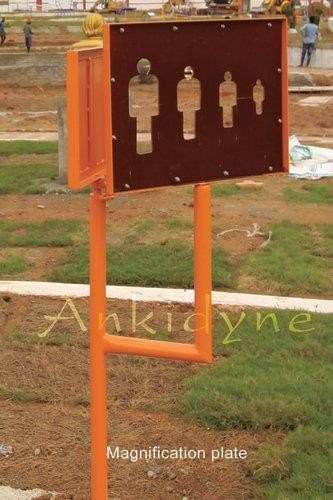 | Science park equipment manufacturer ₹26400 Product Details: Operate Method Manual Age Group All ages Product Type Science Park Models Material Metal Color Orange and Black Style Outdoor... View product → |
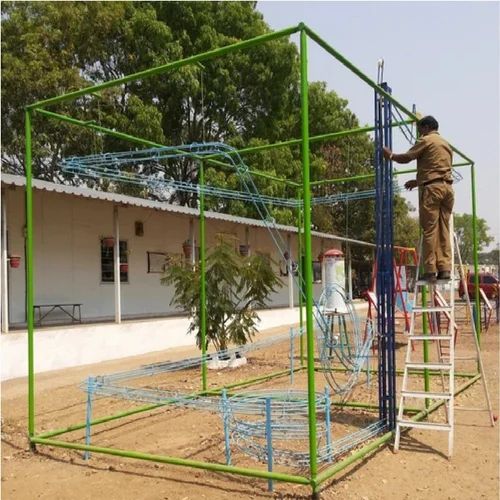 | Science park equipment manufacturer ₹79000 Owing to our rich industry experience, we are engaged in manufacturing and supplying an exclusive range of Science Park Equipment. View product → |
How to Specify and Review an Installation Before You Buy
A station that works on opening day can become an expensive prop when a bearing seizes or an engraved graphic fades. Before approval, demand evidence for both inquiry quality and service-life effort: a specification, test record, inspection schedule and named replacement parts.
- Define the student action, variable, measurement and explanation expected. Link it to asking questions, planning investigations, analyzing data and arguing from evidence.
- Require load rating and material thickness, corrosion protection, anchorage details and a safety review covering pinch points, entrapment and fall zones.
- Require replaceable wear parts for handles, bearings, push buttons, cables, transparent covers and sensor housings, plus inspection intervals, spare-part availability and isolation of one failed element.
- Check measuring features for a stable zero, readable graduations, a reference point, stated accuracy or resolution, and sensor response under sun and rain.
- For water features, require drainage, cleanable surfaces, isolation valves, winterization and a clear potable or non-potable designation.
- Put warranty and installation support in writing, including response times, training, manuals and exclusions. Estimate staff time and total operating effort for daily checks, cleaning, repairs and seasonal shutdown.
| Evidence | Accept | Warning |
|---|---|---|
| Learning task | Prediction, manipulation, measurement and explanation are documented | “Interactive” is the only claim |
| Structural file | Loads, materials, anchorage and safety distances are recorded | No calculations or drawings |
| Maintenance file | Parts, intervals and spares are named | Failed components require closure |
| Operating plan | Cleaning, drainage and repair tasks have assigned time | Costs exclude routine staff work |
Frequently asked questions
What do students do at an interactive science station?
Students make a prediction, change something, observe the result and support an explanation with recorded evidence.
How can teachers turn movement and observation into evidence?
Teachers give students a focused question, identify what to measure and use worksheets or tables to compare observations.
How should you choose a coherent set of science park stations?
Choose stations that connect to one learning concept, suit the available space and create a progression from prediction to measurement and explanation.
What should you review before buying a science park installation?
Review safety zones, accessible routes, drainage, materials, maintenance access, installation documents and how each station supports the intended lesson.
Related products
Science park equipment manufacturer ₹30007 Concept: It consists of a large magnetic board, a set of iron filings, and a set of magnets. Technical specification : Size (l*w*h): 6 * 6 * 9 ft. View product → |
 | Science park equipment manufacturer Science Park Equipment PERCEPTION OF DEPTH ₹25000 Here, a bird suspended at its beak tells the story of center of gravity. Dimension In : 8’ x 7’ Specification Outer Frame– Made of M.S. View product → |
 | KIDS PLAY GROUND MANUFACTURER 4 Seater Seesaw – Fun-Filled Group Play Equipment The 4 Seater Seesaw by Fabrotech Engineers is a durable and engaging playground equipment designed to allow multiple children to play together... View product → |
Science park equipment manufacturer ₹33612 Concept: Experiencing principles of tension, balance, and structural engineering firsthand. View product → |