A dustbin improves waste management only when its material, opening, capacity, location and servicing method match the site. You will be able to plan placement, calculate usable capacity, specify segregation features and compare FRP with other materials before approving a purchase.
Key takeaways
- Choose sealed FRP laminates with UV-resistant gelcoat and corrosion-resistant hardware.
- Place bins near entrances, seating and food areas without blocking pedestrian or service routes.
- Size capacity from visitor volume, collection frequency and expected waste type.
- Ask for laminate details, drainage design, hardware grade and servicing instructions.
What FRP construction changes compared with other bin materials
FRP meaning fibre-reinforced plastic: glass fibres embedded in a resin matrix, usually finished with an exterior gelcoat. The resin controls resistance to moisture, salt spray and cleaning chemicals; laminate thickness affects stiffness and impact resistance; gelcoat protects against abrasion, ultraviolet light and vandalism. Sealed cut edges, drilled holes and corrosion-resistant hardware prevent water entry.
Unsealed details can fail even when the panel itself performs well.
| Material | Strengths | Trade-offs |
|---|---|---|
| FRP versus HDPE | Lighter than concrete and usually stiffer than HDPE; resists corrosion, denting and many chemicals; moulded shapes and colours improve appearance. | Can crack, delaminate or expose fibres after severe impact; heat can soften resin; repairs require laminate work. |
| HDPE | Light, corrosion-proof and easy to clean; dents rather than rusts. | Heat causes greater distortion; scratches and fading affect appearance; repairs are less structural. |
| Galvanised steel bins | Rigid, familiar and repairable by metalwork. | Zinc protection can be breached by scratches, salt or cut edges; dents and rust follow. |
| Stainless steel bins | Strong, clean-looking and highly corrosion-resistant. | Heavier and costlier; dents remain visible and heat transfers quickly. |
| Concrete bins | Very heavy, stable and non-corroding. | Difficult to move or repair; cracks, chips and handling damage are permanent-looking. |
FRP is not automatically weatherproof or non-combustible. Specify a UV-stabilised resin or exterior gelcoat, weathering acceptance criteria for colour, gloss and impact retention, and evidence that edges and fasteners are sealed.
Where ignition risk matters, request fire behaviour data for the complete assembly, including liner; one ASTM E84 result for a component does not prove non-combustibility.
Where to place bins so disposal is convenient and collection is safe
Place bins where people naturally finish an activity, not where collection vehicles happen to stop. A practical park dustbin placement and school waste bin placement plan maps entrances, exits, food areas, play zones, paths, seating, toilets, sports areas and service points before fixing any unit.
- Entrances and exits: install bins just beside, not across, the pedestrian flow, capturing litter before visitors leave.
- Food areas: position bins beside tables and vendors, with leak-resistant liners and frequent servicing; keep drainage away from eating and walking surfaces.
- Play zones: use stable, rounded, obstruction-free units outside play equipment fall zones and circulation routes.
- Walking paths and seating areas: place public-space bins at stopping points while preserving clear pedestrian and wheelchair passage.
- Toilets: locate bins near exits, with separate sanitary-waste provision where required, without narrowing the approach.
- Sports areas: place units beside spectator seating and facility exits, away from playing surfaces and ball paths.
- Service or collection points: provide collection access for staff and vehicles, a level manoeuvring area, and enough room to remove a full liner safely.
Accessible bin height and reach is only one part of accessibility. The approach must be firm, stable and unobstructed; users must reach apertures or flaps without bending, stretching or operating a difficult pedal or mechanism.
Use anchoring to transfer wind, vandalism and relocation forces into paving or a foundation, not the FRP shell. Check safe clearances, wind exposure and a controlled drainage route that never discharges onto a walking route.
How to calculate capacity, spacing and waste-stream configuration
1. Calculate daily waste as users × waste generated per user, then add the extra volume from the busiest event day. Multiply the result by days between collections. The dustbin capacity calculation must use usable litres: shell volume minus the space occupied by the liner, brackets, hood and freeboard.
Request usable litres, not advertised shell volume.
2. Divide that required volume between entrances, food areas, play zones, paths, seating and collection points using a bin spacing method based on foot traffic and waste generation. Increase provision at event locations, then check overflow risk at each collection interval rather than averaging the whole site.
3. Choose one-stream two-stream three-stream bins according to the waste you can actually collect separately.
- One-stream: residual waste in one removable liner.
- Two-stream: residual waste plus dry recyclables, or wet waste where food service dominates.
- Three-stream: residual, dry recyclables and wet waste; add a separate sanitary-waste compartment near toilets when required.
Use leak-resistant, washable, corrosion-resistant removable liners or fixed partitions. Compare liner dimensions, empty weight, footprint and removal height; a full liner that staff must lift above shoulder height will delay servicing and spill.
4. Match aperture size and shape to each stream: a narrow slot suits paper, while a wider opening accepts bulky waste but also admits rain, animals and windblown litter. Use contrasting colour coding with plain-language waste segregation labels; colour alone fails for users with limited colour vision.
Which outdoor specifications protect the bin through weather and servicing
Specify FRP outdoor durability for ultraviolet exposure, monsoon rain, standing water, humidity, heat, impact and repeated emptying before purchase. Ask for:
- Laminate thickness, resin system, gelcoat thickness and UV protection, plus colour or gloss retention criteria after weathering.
- Hardware material, liner material, drainage design, fire information and whether a fire-retardant resin or complete-assembly fire test applies.
- Hooded openings, sloped tops, sealed lid interfaces and controlled drainage; these keep rain out of the liner and prevent discharge onto a walking route.
- Impact resistance, sealed cut edges and fasteners, and a liner design that supports practical liner maintenance during frequent servicing.
| Inspection finding | What it indicates | Required response |
|---|---|---|
| Cracks, exposed glass fibres or loose inserts | Possible structural or anchorage failure | Stop use and obtain a laminate or fixing repair |
| Blisters or delamination | Moisture or bond failure beneath the surface | Investigate; sanding and recoating alone is insufficient |
| Fading, chalking or lost gloss | Cosmetic UV damage | Compare with the agreed weathering criterion |
| Scratches or stained gelcoat | Cosmetic surface damage | Clean, monitor and repair before fibres become exposed |
Inspect anchors, liners, apertures, pedals and spring-loaded flaps separately; moving parts fail through dirt, corrosion and vandalism. Clean with neutral detergent and low-pressure water unless the supplier provides chemical-compatibility limits for disinfectants. Abrasive pads, concentrated solvents and aggressive pressure washing can damage the gelcoat and accelerate water uptake.
What to ask a supplier before approving an FRP dustbin installation
Approve an FRP installation only after the supplier converts catalogue claims into measurable FRP dustbin specifications. Use this supplier checklist:
- Provide a bin drawing showing footprint, total and access height, opening dimensions, and empty weight and footprint.
- State usable litres after deducting the liner, brackets, hood and freeboard.
- Specify liner size, material, leak resistance and removal method, including the lifting height for a full liner.
- Show the partition layout, colour coding and aperture assigned to each waste stream.
- Provide anchoring detail, substrate requirements, fastener type, drainage path and discharge point.
- Identify hardware grade and corrosion protection for hinges, pedals, flaps and brackets.
- State the repair procedure for cracks, delamination, exposed fibres and damaged gelcoat.
- Define cleaning limits, including permitted detergent, pressure and prohibited solvents or abrasives.
- State warranty scope, exclusions, response process and whether labour, anchors, liners and moving parts are covered.
- Confirm replacement-liner availability, lead time and test documents for weathering, fire and structural performance.
Compare quotations by total cost of ownership, not colour or an unverified “durable” or “UV resistant” claim.
| Measure | Quote A | Quote B |
|---|---|---|
| Usable capacity | Litres collected before overflow | Litres collected before overflow |
| Servicing effort | Liner weight, access and removal time | Liner weight, access and removal time |
| Maintenance risk | Parts, cleaning and repair provisions | Parts, cleaning and repair provisions |
| Installation cost | Anchors, groundwork and drainage | Anchors, groundwork and drainage |
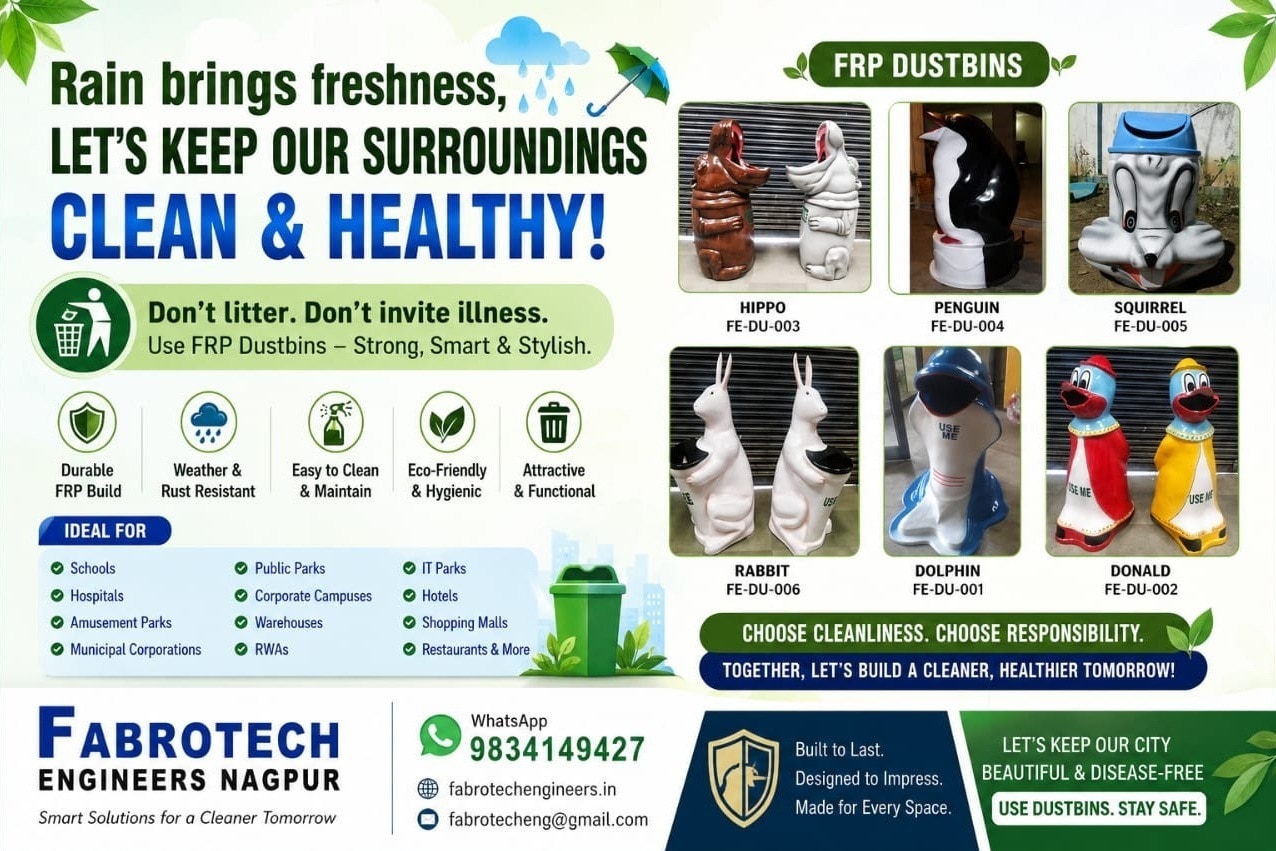
A buyer evaluating products from Fabrotech Engineers can use these questions instead of relying on catalogue height alone. Run a site trial: place one unit in a representative location, observe reach, contamination, overflow, liner handling and collection access during normal and peak use, then approve wider installation only when the written criteria are met.
Related products
 | DUSTBIN MANUFACTURER by Fabrotech Engineers is a robust and high-capacity waste collection solution designed for efficient handling of solid waste in public spaces. View product → |
 | DUSTBIN MANUFACTURER ₹6500 Penguin Dustbin Height -4 ft View product → |
Frequently asked questions
What does FRP construction change compared with metal or plastic bins?
FRP uses glass fibres in a resin matrix, giving the bin moisture resistance without metal corrosion. Laminate thickness affects stiffness and impact resistance, while gelcoat protects the surface from ultraviolet exposure, abrasion and cleaning chemicals.
Where should FRP dustbins be placed in parks and schools?
Place bins beside entrances, seating, food areas, activity zones and exit routes where disposal is convenient. Keep them clear of accessible paths, gates, emergency access and collection-vehicle routes.
How do you calculate dustbin capacity and spacing?
Estimate waste generated between collections, divide it across the planned bins, and add reserve capacity for busy periods. Use separate bins when dry recyclables, wet waste or mixed waste require different collection streams.
Which outdoor specifications protect an FRP dustbin?
Ask for a UV-resistant gelcoat, sealed cut edges and drilled holes, corrosion-resistant fasteners, a stable base, drainage provisions and a surface that tolerates the site’s cleaning chemicals.
What should you ask an FRP dustbin supplier before installation?
Request the laminate construction and thickness, resin and gelcoat specifications, hardware grade, anchoring method, capacity, waste-stream options, cleaning instructions, replacement-part details and servicing requirements.
Related product
 | Science park equipment manufacturer ₹34200 Concept:Three Balls, Challenging Each Other Teach Us The Relationship Between Friction, Texture And Speed. View product → |